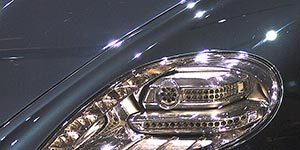
Reflectors gathers light and directs it forward.
Base materials can be steel, aluminum, magnesium, polycarbonate and other plastics. They are designed by using computer aided design (CAD), and shaped in complex forms. It doesnt take a much to see that this process is resource demanding and expensive. The actual optical reflective coating kinda looks like chrome, but its is far from chrome. Reflective coating has changed over the years. In the 1930's they were silverplated. Silver is a great reflective material, its just that it tarnishes and needs to be polished regularly. Aluminum took over in the 70's and it is now dominating automotive headlamps. Reflectivity will typically be 85-88 percent, somewhat dependant on color. This means that 12-15% of the light from a light bulb is considered losses. Losses will be:
The actual aluminum coating process is done in a vacuum chamber in combination with high voltage. They are then painted with a layer of clear UV resistant paint.
There are huge variations in quality of reflective coating.
When handling reflectors after opening a headlight, take some precationary steps. Reflective coating are always more frigile than the supporting plastic. Some coatings are so frigile that even a green paint tape will strip it straight off. Avoid contact with human skin. There is many ways to accomplish that. Wear thin plastic gloves, and/or cover reflector with a sheet of plastic (Glad). The main reson is that keeping them covered is easier than properly cleaning them. When storing for a longer time or shipping, place them into a zip lock bag and then into bubble wrap in case it falls on the floor.
Reflective coatings today are generally very long lasting as long as headlights are kept generally clean and tight in the front and back. Over time it is normal to collect some dust, which can be removed. This is described under "cleaning". If reflective surface is flaking off, oh well, that is when its getting expensive.
Your local hardware store has spray cans you can buy and it says "chrome" on them,
but they are all clear paint with tiny tiny aluminum pieces in.
This does reflect ligth very similar to flat white paint - diffusing it in all directions. Probably not what you wanted at all.
Depending on availabilty and price of a new headlight, considering that
you get new front glass as well, a new headlamp is usually a better alternative.
Reapplying reflecting aluminum as described above is a service that is almost
not avail for small volume. It is possible to chrome them instead. The reflective
properties of chrome has not been verified yet, but it certainly is a great
alternative if new headlamp simply is not available anymore. Here is two links:
http://www.chrometechusa.com/
http://www.muellercorp.com/
Copyright 2001 - 2007 Automotive Lighting FAQ