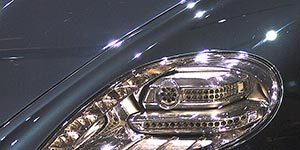
Comparison between OEM HID headlamp and HID retrofitted Halogen headlamp

Legend:
HIDRH=HID retrofitted Halogen headlamp

Light source, focal point and beam distrubution

The headlight reflectors and lenses of OEM HID headlights (=optics) are engineered specifically for use with HID arc capsules. The design not only considers the source focal points, but the amount of lumen to be distributed. These factors are often overlooked when retrofitting is considered. OEM HID optics distributes the increased lumen output of this bulb farther ahead on the road, wider to both sides, without giving more directly in front of the subjected vehicle. This provides motorists with much WIDER AND DEEPER night time vision.
By contrast, halogen headlight optics do not spread the light to the degree of OEM HID. This is simply because a 55 watt halogen bulb (or even a 100 watter) cannot match the lumen output of HID. A lower number of lumens means less light to spread out. And a bigger portion of the total light output have to be placed where its mostly needed: straight ahead. Now, consider what what happens when someone inserts a 2800-3200 lumen HID arc capsule into a headlight designed to distribute only 1/3 of this amount of light. Suddenly, there's too much light in areas that does not need more light:

  • Too much light above cutoff line which would be above horizon on a flat road. This will glare oncoming traffic.
  • Too much light below cutoff line which would glare dangerously towoards oncoming traffic on a hill.
  • Too much foreground lighting. The driver will get the intense foreground lighting back in his own eyes, making eyes less sensitive for down the road illumination beyond 70 meters down the road.

    Beam pattern

    Compare the beam patterns of HIDRH vs. standard halogen lamp. Here you will see a very noticeable difference. A HIDRH will produce a brighter concentration of light compared to it's halogen cousin, no question, but it will not come close to the depth and width of light distribution created by an OEM HID light system. For other drivers, an OEM HID system will be easier and less fatiguing to look at than a HIDRH. That is because there is less glare. OEM HID reflector systems does not have directly visible HID bulb from above cutoff like many HIDRH systems have. OEM HID reflector systems have a much better cutoff than HIDRH systems have. The list of reasons for vague (or missing) cutoff line are too long to mention here. Many of them are discussed under "Special Topics" that has a section for each Halogen type bulb.

    Beam color

    Consider that the goal of a good halogen headlight system (actually, any headlight system) - say one designed for a 55 watt 9006 bulb with ~1200 lumen output - is to most efficiently and evenly distribute 1100 lumens of light. It must do so in a way that meets Federal requirements for intensity, illumination points, glare, etc., in order to be legally used on road vehicles. Taking these parameters into account, engineers create headlight optics to meet these goals as best they can. Retrofitting an HID bulb into a halogen designed headlight "optically overloads" this headlight system with an abundance of white "primary light", and does not allow HID "secondary light" (i.e. the blue/purple tinge - or "throw-away light as Dan Stern calls it) to be seen (from the outside). As proof of this, compare a HIDRH to an OEM HID headlight system (of course, compare reflector <--> reflector, projector <--> projector). You will notice that the retrofit will look more untidy, colorwise. Yellow to orange color as foreground lighting is very common. Brown spots and shadows has been reported.
    Too much light *and* a completely different type of light source (electrical arc vs. burning filament). In short, incompatibility of the HID bulb and halogen-designed headlight optics are the reason for the difference in external appearance between OEM HID and HIDRH.

    Mechanical and weather proofing

    Most HID retro kit comes with bulb base that are bigger, so the normal clip that you would normally use on a Halogen bulb, will not fit anymore. Also, many cars have the entire rear part of the headlamp sealed from the elements. Will the new bigger High Voltage plug fit in there without making a big hole?

    Price and conclusion:

    The OEM HID headlamps are $400 to $2500, all depending on car, or wether they are bought new or used. If there is OEM HID headlamps available, it will be a better choice over a retrofit kit. With a lot of effort, you can make a retrofit HID for less money, but most in most cases, never reach the same total quality

    Go up in menu system